
Santa Ana Wrongful Death Lawyer
Trusted Santa Ana Wrongful Death Attorney
What a Santa Ana Wrongful Death Lawyer Can Do for Your Family
Losing a family member because of someone else’s carelessness, a workplace accident, a dangerous product, or even a deliberate act leaves you with a grief that is hard to put into words. On top of that, you may face funeral bills, lost income, and unanswered questions about what happened.
California law lets certain family members hold the person or company responsible financially accountable for that loss. A Santa Ana wrongful death lawyer at Duque & Price can help your family understand those rights and start moving toward answers.
Attorney Brent Duque has practiced personal injury law in California since 2005 and is fluent in both English and Spanish, so your family can discuss what happened in whichever language feels most comfortable. Reach out to talk through what your family is facing and the options available to you.
No amount of money replaces the person you lost, but a recovery may help ease the financial pressure that follows and bring a measure of accountability for what happened.
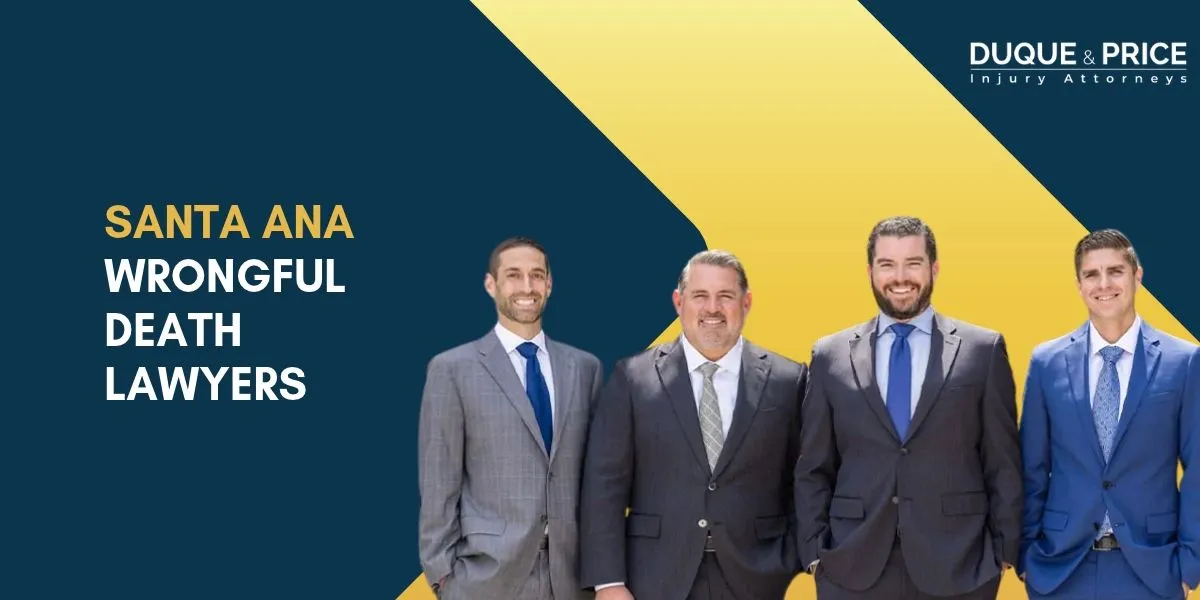
Filing a Wrongful Death Claim in Santa Ana, CA
When you file a wrongful death claim, you’re alleging that another person or company caused your loved one’s death through negligence or a wrongful act. A wrongful death claim is a civil case, separate from any criminal proceedings, and generally requires a lower standard of proof.
Instead of proving guilt “beyond a reasonable doubt,” your case only has to show it’s more likely than not, a standard called a preponderance of the evidence, that the defendant caused the death. If a jury agrees, the defendant pays money damages.
No one goes to jail in a wrongful death case, even when the same event also leads to a separate criminal charge against the person responsible.
Who Can File a Wrongful Death Lawsuit Under California Law
California limits who can bring a wrongful death claim, so not every relative qualifies automatically.
Under California Code of Civil Procedure Section 377.60, the right to sue first belongs to the decedent’s surviving spouse, domestic partner, and children, including any grandchildren whose own parent (the decedent’s child) died before them. If there are none, the people who would inherit from the decedent if there were no will can sue. That usually means parents or siblings step in when there’s no surviving spouse or child.
Whether or not they qualify under that first group, dependents such as a putative spouse, children of the putative spouse, stepchildren, or parents can also bring a claim if they were dependent on the decedent. If your loved one was a child, the surviving parents can bring the claim, and grandparents can step in if the parents didn’t survive.
A wrongful death attorney can review your family’s situation and confirm who has the right to file before a deadline closes that door.
What Damages Are Available to Surviving Family Members
Losing a family member creates both financial and emotional costs, and California law separates the damages a family can recover into two groups:
- Economic damages cover losses you can calculate with some precision, including:
- The financial support your loved one would have provided over their expected lifetime
- The value of their household services
- The cost of the funeral and burial
- Non-economic damages cover losses that are harder to put a number on, including:
- The loss of your loved one’s love
- The loss of their companionship
- The loss of their guidance
A jury weighs these losses case by case, since no fixed formula fits every family.
Depending on the facts, you may also be able to recover your loved one’s financial losses from before death through a separate claim brought on behalf of the estate. An attorney can explain this based on what happened.
Common Causes Behind Santa Ana Wrongful Death Claims We Handle
Wrongful death claims arise from many types of incidents, and the facts of each one change how you prove fault. The firm handles wrongful death claims stemming from:
- Car, motorcycle, and truck collisions on local roads and freeways, including the Interstate 5 and State Route 55 corridors running through Santa Ana
- Workplace accidents and construction site falls
- Medical errors, including delayed diagnosis and surgical mistakes
- Defective or poorly designed products
- Unsafe conditions on commercial or residential property
- Violent or intentional acts that also give rise to a criminal case
Each category requires different proof, from police collision reports to medical records to a product’s design history. Knowing which category your case falls into early on helps preserve the evidence your claim will need later.
How Long You Have to File a Wrongful Death Claim in California
California gives families a limited window to file a wrongful death lawsuit. Under California Code of Civil Procedure Section 335.1, claims must generally be filed within two years of the date of death. Medical malpractice claims can have a shorter deadline.
If the responsible party is a government agency, such as a public school district, a city department, or a public hospital, the deadline is shorter. You must usually file a formal claim with that agency within six months of the death under California Government Code Section 911.2, well before the two-year deadline arrives.
Missing a deadline usually ends your right to recover money, no matter how strong the case looks otherwise. Evidence also fades with time. Witnesses can move away, surveillance footage can get erased, and vehicles can get repaired or scrapped.
This reflects California law as of October 2026.
Where a Santa Ana Wrongful Death Case Gets Heard
Most wrongful death lawsuits arising in Santa Ana are filed at the Orange County Superior Court’s Central Justice Center, located at 700 Civic Center Drive West in Santa Ana. This courthouse handles unlimited civil, limited civil, and small claims matters for Santa Ana, Orange, Tustin, and Villa Park, plus certain civil cases from across Orange County.
Filing in the right courthouse, naming the correct defendant, and meeting every local procedural rule all matter before a case can move forward. A Santa Ana wrongful death attorney can help your family meet those requirements without losing time your case can’t afford to lose.
Why Families Choose Our Santa Ana Wrongful Death Attorneys
Brent Duque has been licensed to practice law in California since 2005. He is also bilingual in English and Spanish, which helps families discuss a loss that affects the whole household without a language barrier getting in the way.
Matthew Price, who joined the firm in 2013, graduated cum laude from Chapman University’s Dale E. Fowler School of Law, carries an Avvo Rating of 10.0, the platform’s highest tier, and has appeared as a featured guest on the Lawterature legal podcast. Jordan Davidoff spent part of his early career representing insurance companies against personal injury claims before shifting in 2014 to represent injured plaintiffs and grieving families instead. That gives him insight into how insurers evaluate and resist these claims.
Duque & Price operates offices in Costa Mesa, Los Angeles, Riverside, and Temecula, and its Costa Mesa office is a short drive from Santa Ana.
Frequently Asked Questions
Q: Do I need to hire a lawyer right away, or can it wait?
A: Insurance adjusters often reach out to grieving families within days of a death, and anything you say to them can affect your claim later. Speaking with an attorney early may help protect evidence and give your family guidance before you talk with an insurance company.
Q: What if my family member was partly at fault for what happened?
A: California follows a pure comparative negligence rule, which means a jury can still award damages even if your loved one shared some fault. The jury simply reduces the total award by the percentage of fault assigned to your loved one.
Q: Do we have to wait until a related criminal case is finished before filing a civil claim?
A: No. A wrongful death lawsuit and a criminal prosecution are separate cases with different rules and timelines, and you generally don’t have to wait for one to resolve the other. In some situations, a pending criminal case can even help establish facts useful in the civil claim.
Q: How much does it cost to hire a Santa Ana wrongful death lawyer?
A: Duque & Price works on a contingency fee basis, which means you pay no attorney fees upfront and the firm is paid only if you recover compensation. A consultation to review your case is free.
Q: Who decides how a settlement gets divided among family members?
A: When multiple relatives qualify to bring a claim, the court decides how the award is divided among them. This matters most when a spouse, children, and other dependents all have a stake in the same case.
Q: My loved one died in a crash near Santa Ana but our family lives in another county or state. Can we still file here?
A: Yes, in most cases you can file in the Orange County court connected to where the death or the underlying incident occurred, regardless of where you personally live. An attorney can confirm the correct venue based on where the collision or other incident happened.
Talk to a Santa Ana Wrongful Death Lawyer Today
No one can undo the loss your family has suffered, but you don’t have to work through the legal and financial side of it without help. A consultation with Duque & Price is free, and the firm works on a contingency fee basis, so you pay no attorney fees unless money is recovered for your family. Contact us today to talk through what happened and what your family’s options are.
Santa Ana, CA Wrongful Death Legal Resources
- California Legislative Information – Code of Civil Procedure Section 377.60 (Wrongful Death Standing)
- California Legislative Information – Code of Civil Procedure Section 335.1 (Two-Year Statute of Limitations)
- California Legislative Information – Government Code Section 911.2 (Six-Month Government Claim Deadline)
- Superior Court of California, County of Orange – Central Justice Center Civil Filing Location
About Santa Ana, CA
The Bowers Museum stands as one of Santa Ana’s premier cultural landmarks, welcoming visitors to explore world-class art and educational exhibits. However, preventable fatalities remain a serious concern across the city; California Office of Traffic Safety data recorded 14 fatal pedestrian and bicycle traffic crashes in Santa Ana during 2024 alongside 419 statewide workplace fatalities. In response, local leaders adopted the Santa Ana Vision Zero Plan to eliminate fatal roadway collisions through street redesigns and targeted enforcement, helping protect local families and strengthen community resilience.
Free Consultation
Fields Marked With An ” *” Are Required

© Copyright 2026 Duque & Price. All rights reserved.
*Images are obtained under license from Canva and other third-party stock image providers, with attribution included where required.
Digital Marketing By 