
Torrance Premises Liability Lawyer
Torrance Premises Liability Attorney
A Torrance Premises Liability Lawyer Can Help You Find Answers
A fall, trip, or injury on someone else’s property can leave you with medical bills piling up and no clear sense of who is responsible. This can happen at a private home, an apartment complex, a shopping center, or a public park, and the property owner’s insurance company may not tell you what your rights actually are.
A Torrance premises liability lawyer at Duque & Price can look at what happened and tell you whether the property owner failed to keep the location safe. Attorney Brent A. Duque has been licensed to practice law in California since 2005 and handles cases in both English and Spanish.
He has built a practice around helping people injured by someone else’s negligence, and he can walk you through what a claim against a home, business, or public property actually involves. Reach out to talk through what happened and learn what your options look like once someone reviews the details of your fall.
What Property Owners Owe You Under California Law
California law does not let a property owner off the hook just because an injury happened on their land. Under Civil Code Section 1714, anyone who controls a property, whether as an owner, tenant, or manager, must use reasonable care to keep it safe for the people who come onto it.
This duty applies to a homeowner hosting a guest, a store owner running a business, and a city maintaining a sidewalk or park. When an owner fails to use that reasonable care, the law calls it negligence.
If a hazard exists that a reasonable owner would have fixed or warned about, and it causes an injury, the owner can be held responsible. That can include medical bills, lost wages, and other losses.
Proving the Property Owner Knew About the Hazard
Just because a property owner says they didn’t know about a hazard doesn’t mean they are off the hook. California law also holds an owner responsible if they should have known about a dangerous condition through reasonable inspection, even without direct proof they saw it.
This is called constructive notice, and it usually comes down to how long the hazard existed before someone got hurt. Here’s a simple way to picture it. If a customer slipped on a drink that had spilled in a grocery store aisle only moments before, proving constructive notice can be difficult because the store had almost no time to find it.
If the liquid had instead been leaking from a cooler for an hour, or had footprints and cart tracks through it, that condition suggests it was there long enough that an employee should have noticed and cleaned it up.
Slip, Trip, and Fall Injuries We Handle for Torrance Clients
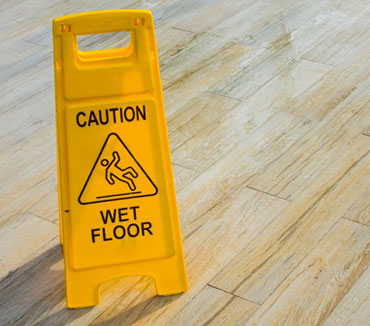
A slip and fall usually happens because of a wet, oily, or otherwise slippery surface, and the person typically falls backward. These falls often injure the spine, back, and shoulders, and a hard enough impact to the head can cause a traumatic brain injury or, in the worst cases, death.
A trip and fall happens differently. Cracks, potholes, and uneven pavement in a parking lot or on a sidewalk are common causes. Poor lighting on stairs or in a hallway can also cause someone to trip over an object they never saw. With a trip and fall, the person usually falls forward, which tends to injure the face, jaw, wrists, and ribs.
Not every fall leads to a valid legal claim, and an insurance adjuster may look for reasons to deny one. A Torrance premises liability lawyer at our firm can look at the details of your fall and tell you honestly whether you have a case worth pursuing.
Other Premises Liability Claims Beyond Slip and Falls
Most people think of premises liability in terms of slip and fall or trip and fall cases, but the category covers much more across Southern California. It also includes animal attacks, swimming pool injuries, elevator and escalator accidents, amusement park injuries, and inadequate security that lets a preventable crime happen.
Common injuries at private homes and residential properties include:
- Drowning or near-drowning in a swimming pool
- Spinal and neck injuries from diving into shallow water
- Electrocution from faulty wiring
- Dog bites and other animal attacks
- Harm from inadequate or negligent security
Common injuries at amusement parks and theme parks include:
- Whiplash
- Fractures
- Internal injuries
- Traumatic brain injuries
Common injuries involving elevators and escalators include:
- Falls caused by sudden stops or malfunctioning doors
- An elevator stopping above or below the correct floor
- Entrapment injuries from worn or broken parts
Whatever type of property caused your injury, the same basic question applies. Did the person or entity in control of that property use reasonable care to keep it safe?
How Long You Have to File a Premises Liability Claim in California
California generally gives injured people two years from the date of the injury to file a premises liability lawsuit, under California Code of Civil Procedure Section 335.1. Waiting too long can cost you the right to recover anything at all, since a court will almost always dismiss a claim filed after the deadline passes, no matter how strong the evidence is.
The deadline gets much shorter if a government entity owns or controls the property where you got hurt, such as a city sidewalk, a public park, or a county building. In that situation, you generally must file a formal written claim with the government agency within six months of the injury, long before the two-year deadline would otherwise apply.
Missing this shorter window can end your case before it ever reaches a courtroom, which is why it helps to sort out who controls the property as early as possible. This information reflects California law as of October 2026.
The Torrance Courthouse and Where Your Case Will Be Heard
If your injury happened in Torrance or a nearby South Bay city, a lawsuit will typically be filed in the Los Angeles County Superior Court’s Southwest District, housed at the Torrance Courthouse on Maple Avenue.
This courthouse handles civil cases arising not just in Torrance, but also in Redondo Beach, Hermosa Beach, Manhattan Beach, Gardena, Lawndale, Lomita, and the Palos Verdes Peninsula. Knowing which courthouse and judicial district will hear a case matters, because local filing rules and scheduling practices can vary between districts.
A premises liability claim against a shopping center near Hawthorne Boulevard would tend to move through this same Southwest District courthouse. So would a claim over a public park close to the Torrance Civic Center or an apartment complex off Pacific Coast Highway. Having a sense of that process from the start can help you know what to expect as your case moves forward.
The Attorneys Handling Your Torrance Premises Liability Claim
Brent A. Duque has been licensed to practice law in California since 2005, with a career built around representing people injured by someone else’s negligence. Attorney Jordan Davidoff brings a different angle to premises liability cases.
Early in his career, Davidoff worked the defense side, handling injury lawsuits for insurance companies, before shifting in 2014 to represent injured plaintiffs instead. That background gives him insight into how insurance carriers evaluate injury claims.
Attorney Matthew Price, who holds a 10.0 Avvo rating, the platform’s highest tier, graduated cum laude from Chapman University’s Dale E. Fowler School of Law with an emphasis in advocacy and dispute resolution.
The firm’s attorneys work out of offices across Southern California, including Costa Mesa, Los Angeles, Riverside, and Temecula, and can meet with clients who were injured in the Torrance area.
Frequently Asked Questions
Q: How much does it cost to hire a premises liability lawyer in Torrance?
A: Duque & Price works on a contingency fee basis, which means you pay no attorney fees upfront and the firm is paid only if you recover compensation. A consultation to review your case is free.
Q: What if I was partly responsible for my own fall?
A: California follows a rule called comparative negligence. You can still recover compensation even if you were partly at fault for your fall, though the court will reduce your compensation by your percentage of responsibility.
Q: Who is responsible if I tripped on a broken sidewalk in Torrance?
A: It depends on who controls that section of sidewalk. Responsibility can fall on the adjacent property owner or on the City of Torrance, depending on local rules. Figuring out who controlled the area is often the first step in a sidewalk trip and fall claim.
Q: What should I do immediately after getting hurt on someone else’s property?
A: Get medical care, take photos of the hazard and your injuries if you’re able, and report what happened to the property owner or manager. Avoid giving a recorded statement to an insurance company before speaking with a lawyer.
Q: Can I still file a claim if the hazard was fixed before I took pictures?
A: Yes. Incident reports, maintenance records, witness statements, and surveillance footage can all help establish that a dangerous condition existed, even without your own photos of the hazard itself.
Q: Does a landlord or a tenant hold responsibility for an injury inside a rental property?
A: It depends on who controlled the area where the hazard existed. Landlords are typically responsible for common areas like stairwells and parking lots, while tenants control the interior of their own unit, unless the landlord knew about an interior hazard and failed to fix it.
Q: Is a dog bite handled differently from other premises liability claims?
A: Dog bites often work differently from other premises claims. California generally holds dog owners responsible for a bite without requiring proof the owner was careless, as long as you were lawfully on the property or in a public place at the time.
Talk to a Torrance Premises Liability Lawyer Today
If you were hurt on someone else’s property in Torrance or elsewhere in the South Bay, you do not have to sort out who is responsible on your own. The firm works on a contingency fee basis, so you pay no attorney fees unless it recovers compensation for you. Schedule a free consultation to talk about what happened and what your legal options look like.
Practice Areas




Free Consultation
Fields Marked With An ” *” Are Required

© Copyright 2026 Duque & Price. All rights reserved.
*Images are obtained under license from Canva and other third-party stock image providers, with attribution included where required.
Digital Marketing By 