
Pasadena Back and Neck Injury Attorney
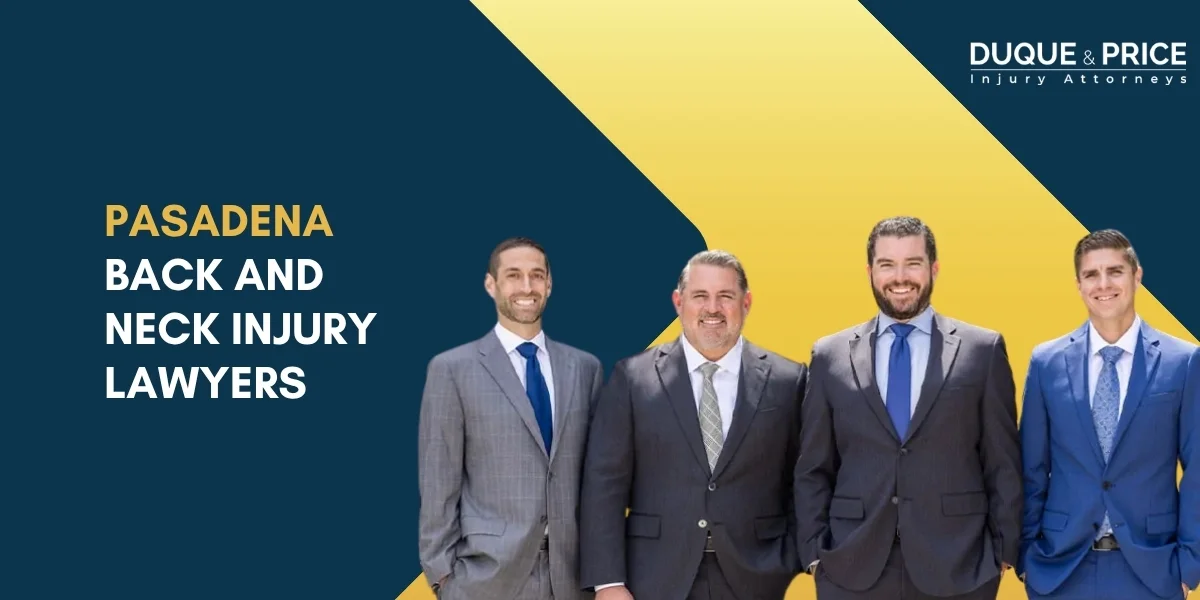
Dedicated Back and Neck Injury Lawyer in Pasadena, CA
Whiplash sounds minor right up until the bills start arriving: imaging, physical therapy, maybe an injection or two, and for some people, eventually a conversation about surgery. Insurance companies count on injured drivers not knowing how far that list can go before they ever make an offer.
That gap between what an adjuster offers and what treatment actually ends up costing is where a Pasadena back and neck injury lawyer earns their keep. Brent A. Duque opened Duque & Price in 2005 and has spent the two decades since watching insurers undervalue exactly this type of injury. That’s why the firm treats a normal-looking X-ray as the start of an investigation, not the end of one.
A police report calling the crash “minor” does not decide what the injury is worth. What decides it is the imaging, the specialist notes, and the treatment record built starting now. Contact our personal injury lawyer us for a free case evaluation.
| Licensed in California Since 2005 | Four Offices Across Southern California | Free Consultations Available | English & Spanish Spoken |
When a Normal X-Ray Doesn’t Mean a Normal Injury
Fractures show up clearly on an X-ray. Disc injuries, pinched nerves, and soft tissue damage usually do not, and that gap is exactly what insurance companies lean on to argue a claim is exaggerated.
The injuries that often get undervalued this way include:
- Herniated or bulging discs
- Pinched or compressed nerves causing arm or leg pain
- Facet joint damage
- Whiplash-related muscle and ligament tears
- Chronic headaches tied to a neck injury
- Spinal fractures that do not show up until later imaging
An MRI, not an X-ray, is usually what proves one of these is real, and getting that imaging ordered early keeps a claim from stalling on a technicality.
The Price Tag on a Pasadena Back or Neck Injury
A herniated disc alone can mean an MRI, weeks of physical therapy, and an epidural injection before surgery ever comes up. A cervical fusion regularly runs into the tens of thousands of dollars once hospital fees and hardware are added in.
Attorney Matthew R. Price, who holds a trial advocacy certificate from Chapman University, focuses on translating that medical reality into a number an insurer cannot easily talk down.
California still allows recovery even when a driver shares some fault for the crash, with the payout reduced by that percentage rather than wiped out.
How a Pasadena Back and Neck Injury Case Actually Gets Built?
Documenting an injury is only half the work. Once the medical picture is clear, the firm identifies every insurance policy that might apply, calculates lost wages and future treatment costs rather than accepting a rough estimate, and sends a demand backed by records instead of a guess.
Attorney Jordan H. Davidoff spent the early part of his career on the defense side of personal injury litigation, and that experience shapes how the firm anticipates an adjuster’s objections before they show up in writing.
Most claims settle without a lawsuit. When one doesn’t, the case moves into litigation, prepared the same way it was handled from day one, so the shift from negotiation to filing doesn’t cost any momentum.
The Freeways Behind Many Pasadena Back and Neck Claims
The 210 and 110 freeways carry most of the traffic into and out of Pasadena, and they also produce a steady share of the rear-end and lane-change collisions behind the disc and soft-tissue injuries this firm handles.
Crash victims from those corridors often end up at Huntington Hospital, and those emergency records frequently become some of the strongest evidence in a claim.
Cases that do not settle are generally filed at the Pasadena Courthouse on East Walnut Street, part of the LA County Superior Court’s Northeast District.
FAQs About Pasadena, CA Back and Neck Injury Laws
How much does hiring a Pasadena back and neck injury lawyer cost?
In Pasadena, nothing upfront. Duque & Price works on contingency, so payment only comes out of money actually recovered, and the first conversation is free.
What if my pain did not start until days after the crash in Pasadena?
In Pasadena, that is common with whiplash and disc injuries, since inflammation builds over time. A delayed onset does not weaken a claim, as long as you see a doctor promptly once symptoms appear
Can I still recover if my X-ray came back normal?
Yes. Many serious injuries, including herniated discs and soft tissue damage, do not show up on a basic X-ray and need an MRI to diagnose properly.
What if I was partly at fault for the accident in California?
California’s comparative negligence rule still allows recovery when fault is shared. The award gets reduced by the assigned percentage, not eliminated.
Should I give the insurance company a recorded statement in Pasadena?
In Pasadena, not without talking to an attorney first. Adjusters use recorded statements to lock in details before the full injury is known, and nothing requires giving one.
How long do I have to file a claim overall in California?
In California, you generally have two years from the date of the crash to file, under CCP Section 335.1. That clock can start later if your injury wasn’t discovered right away, and it can pause if the injured person is a minor. However, when a city vehicle, a Metro bus, or a road defect is involved, Government Code Section 911.2 cuts that filing window down to six months instead of two years, a deadline that catches people off guard far more often than the standard one.
For more information about California’s filing deadlines, see this guide to the California personal injury statute of limitations.
Find Out What a Pasadena Back and Neck Injury Lawyer Has to Say About Your Case
Police reports do not diagnose injuries, and insurance adjusters know most people do not realize that until months later. Contact Duque & Price for a free consultation and find out what a Pasadena back and neck injury claim is actually worth before accepting anything from an insurer.
Free Consultation
Fields Marked With An ” *” Are Required

© Copyright 2026 Duque & Price. All rights reserved.
*Images are obtained under license from Canva and other third-party stock image providers, with attribution included where required.
Digital Marketing By 